Showing posts with label chemistry. Show all posts

Tuesday, February 3, 2015

What I Learned from Watching Student Produced Chemistry Videos

Assignment: Balance Word Equations Video

Use iMovie, Explain Everything or any software or app, you are comfortable with, to create a YouTube video explaining how to balance a chemical equation from a word problem including determining classification of the type of reaction taking place..  You may use any means necessary to explain the process, white boards, table tops, presentation software, pen and paper.  

Upon completing your video, post it on the class YouTube Site. 

email: $%$$%$%%$%$%$
password: %#$%#%$%$

Please copy and paste the url for your YouTube video in the WRITE SUBMISSION box below.

(We use BlackBoard as our LMS)

A   aluminum bromide + chlorine gas yields aluminum chloride and bromine gas
B   sodium phosphate + calcium chloride yields calcium phosphate + sodium chloride
C   potassium phosphate + aluminum nitrate yields potassium nitrate + aluminum phosphate
D   sulfuric acid + sodium hydroxide yields water + sodium sulfate 
E   zinc metal reacts with lead nitrate to yield zinc nitrate and lead

Your reaction is determined by where you are seated at your tables.

^Front of Room
Door SideLab TablesWindow Side 

In years past, I would have assigned a worksheet of 20 problems of balancing word equations for students to complete at home.  I wish I could say that I am the type of teacher that would have sat down and corrected each of the 20 balancing equations for each of my 50 Honor Chemistry students, complete with corrections and personal notes to help the students understand their mistakes, but I am a realist and like most of you this would have been a check your answers   with your partners and turn it in, check mark and record assignment. 

However, this year I am having students post videos on our class YouTube Channel. These videos are meant as a means of students demonstrating their understanding of the process of solving problems. Although it takes just as much time to sit down and watch fifty 4 to 5 minute videos as it would to correct the papers, I have found the time more beneficial for both me as an educator and my students. 

I have learned more about what my students understand and what I may need to evaluate in my own teaching as a result of students completing these videos. Not to mention that students now have a library videos demonstrating both good and bad problem solving as a resource for learning and review. 

Benefits of the Video Assignment

- Students make a more honest attempt to understand because their work will be on public display. 
- Students become more aware of the importance of process versus just finding the right answer.
- Students take greater ownership of their learning.
- Students can teach and learn from other. 
- Students are immersed in the technology.
- Students are creating their own learning resource.
- Students gain skills in organization and planning.
- Students develop presentation skills.
- Students utilize proper vocabulary
- Students self assess work. 

For me as an educator, I gain more from listening to a student solve one problem than I would correcting twenty problems.  I can see and hear where students demonstrate a thorough understanding and where there may be gaps in their comprehension of the material. I can determine which areas of the topic I need to re-teach and which students I need to pull aside for additional instruction. 

 
Every student has a movie studio in their pocket or backpack between all of the software and apps that allow students to make their own videos.  Putting this to use as a means of creating a teaching and learning assignment is almost a no-brainer.  The benefits in my classroom have been tremendous. 


Saturday, October 18, 2014

MORE MODELS SOLIDIFY CONTENT KNOWLEDGE

PERIODIC TREND MODLES BUILD ON CONTENT KNOWLEDGE


"Mr. Miller, did you realize that the periodic table is arranged in more ways than just atomic number?"

"There is a definite pattern that for the elements!!!"

These are just two of the many statements that students shared with me as they built models based upon electronegativity and ionization energy in class this week.


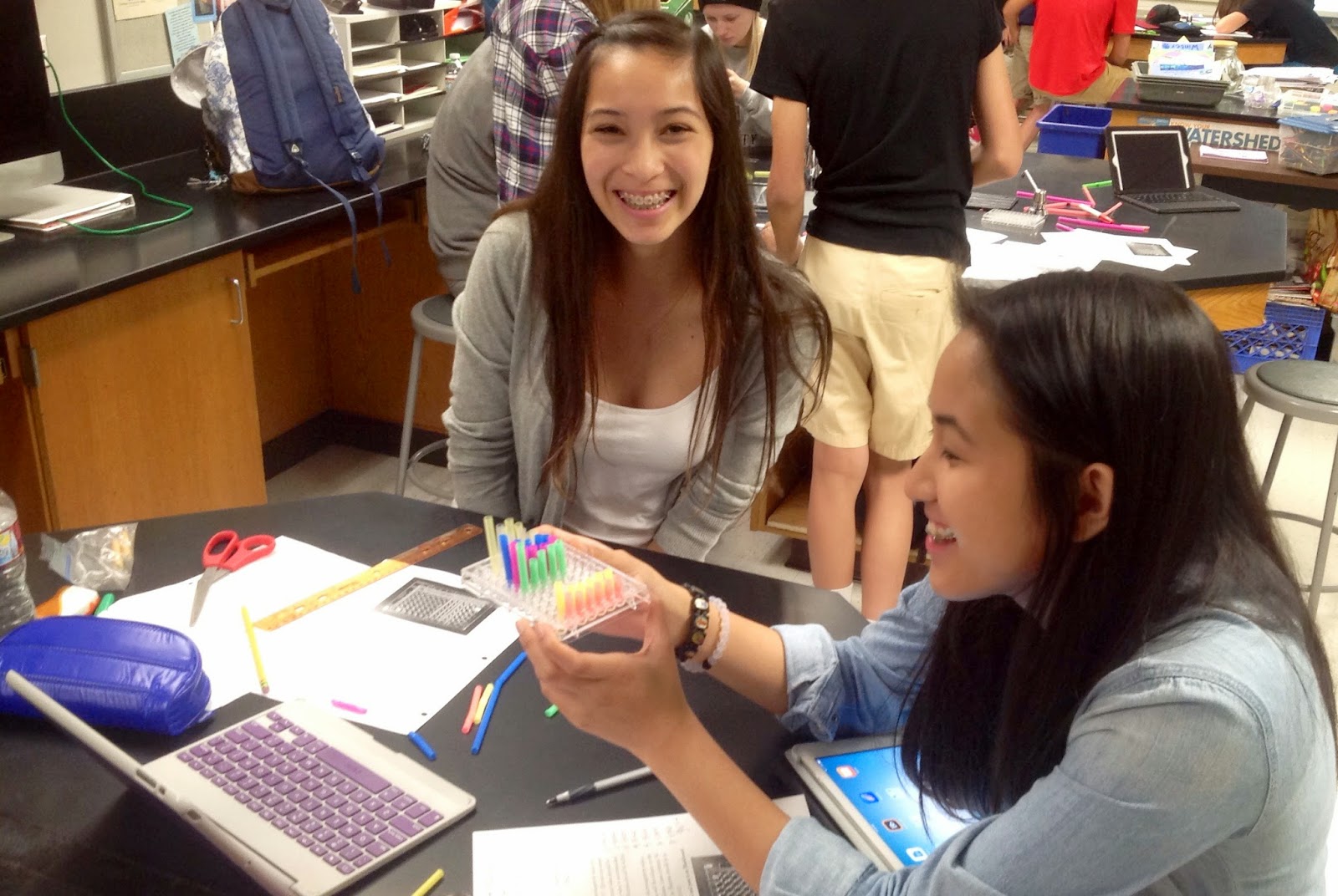
The Periodic Trends Lab (Electronegativity in 3D) is very basic and utilizes drinking straws (color straws @ Smart & Final) and a 96 well tray. Students cut straw lengths to match the values of electronegativity values.  As students build the model they can see they very distinct pattern of the periodic arrangement of the elements based upon electronegativity.  


Students followed up the Electronegativity trend model by creating a similar model for Ionization Energy using a scale of 1 cm = 300 kJ.  


MODELS - APPLY AND SYNTHESIZE FLIPPED CONTENT

STUDENTS BUILD MODELS TO APPLY AND SYNTHESIZE FLIPPED CONTENT

Models can be a highly effective means of providing pathways for students to synthesize and apply the content they are provided. 

In the Flipped Classroom I have adopted for my chemistry courses it has become an essential aspect of the curriculum, to use student developed models to transition from the media content they view at home to the application of the material in the classroom. 

Models can range from simple to complex but I have found that it is the simplicity of a model that students can truly develop their own understanding and insights in a way that allows them to share with their peers and take ownership of their knowledge. 

We recently used a Bohr Model template and clay to introduce the structure of the atom, the arrangement of subatomic particles and the intricacies of isotopes, and ions. 

Students built models, took pictures on their iPads and annotated them using a an app called Skitch and then created iMovies about the isotopes of the first 20 elements. Although the Bohr Model has several flaws and is not a true arrangement of the electrons of an atom, building these models laid a solid foundation for students as they continued into the cloud model, electron and orbital configuration and eventually to Lewis Dot structures and the VSEPR models. 


Prior to Flipping my classroom I would not have had time to have students do this in class and be able to have the more in depth discussions I engaged in with my students concerning the importance of electron arrangement, density of the nucleus, the neutron as the the defining value of the atom and the shielding effect created by the neutrons, all generated from student questions and discussions I overheard as I was fulfilling my role as "Guide on the Side" rather than "Sage on the Stage".


Thursday, October 2, 2014

FLIPPING IS MORE THAN JUST WATCHING VIDEOS AT HOME

What is Flipping and Why?

I have flipped parts of many of my classes for several years now.  I have flipped parts of Anatomy, Biology and Chemistry courses.  This year I have committed to FLIPPING my entire Honors Chemistry Course.  I use SOPHIA.org to create tutorials and playlists of my videos (SMARTERTEACHER Sophia) which are available also available on You Tube. I use Screencast-o-matic to create my own video lessons, and supplement my own videos with videos from Tyler Dewitt, Paul Anderson (Bozeman Science), Brian Swarthout and Steve Spangler and Crash Course. I have now completed the first five weeks of the course and four chapters of the text. My students have engaged in labs, hands on activities and projects in every block this year (See Page).   

I have put together a brief video to explain this to the parents of my students. 


    The Best Aspects of Flipping My Class

  • Student Focused Classroom
  • Authentic Application
  • Improved use of Technology
  • Student Ownership of Their Learning
  • Use of Formative Assessment
  • TIME, TIME, TIME!!!!!
Student Focused Classroom
My classroom has become more them and less of me.  I spend more time engaged in authentic discussions with the students addressing their questions and understanding. I have spent very little time in lecture, directing the class and in disciplining students.

Authentic Application
My students have had ten class meetings and have done a lab, hands on activity or engaged in project based learning. (See Page)

Improved Use of Technology
We became a one to one iPad school this year and have converted from Moodle to BlackBoard for our LMS. I have increased the the interaction for my students and technology.
  •  Students access the BlackBoard LMS on their iPads
  •  Students download pdfs of lecture notes and worksheets and upload them to Notability to take notes or complete work.
  •  Periodic Table is a html interface for students to access on the iPad
  •  Students have downloaded and followed lab instructions on their iPads
  •  Students have used the iPad to document lab data and observations.
  •  Students use the iPad calculator to complete problem solving
  •  Students have created photo collages and iMovies of class activities and labs
  •  Students have used the Skitch app to annotate photos of lab observations
  •  Students have followed lessons on NearPod app
  •  Students have accessed SOPHIA Playlists and Tutorials on their iPads
  •  Students have used the iPads to search information and research
  •  Students have viewed TEDs and completed TEDitorial assignments on iPads
  •  Students have created Infographics using their iPads
  •  Students have submitted discussion points to a Padlet Graffiti Wall on the SMART Board. 
Student Ownership of Their Learning
Students learn on their time at their pace. Students are able to access Sophia playlists whenever the can wherever they are.  

Increased Use of Formative Assessment
I am more aware of student understanding and application of material by having the time to authentically engage with students beyond simply sharing content. I am therefore, able to evaluate the learning process in my classroom for both my students and as an educator. 

TIME! TIME! TIME!
Time in class to engage in the types of activities that engage students in the development of their skills for learning. 


Saturday, April 12, 2014

Colligative Properties - And Its So Tasty Too!!!

Colligative Properties - An Its So Tasty Too!!!

What if everyday your students came to the door of your chemistry classroom with ANTICIPATION and EXCITEMENT?

What if your chemistry students spent more time smiling in your class than grimacing with angst over another lecture or worksheet?

What if you couldn't wait to get to your chemistry class because you wanted to see how your students would respond to the activities you have planned for that day?

What if you made ICE CREAM and ate it in the science lab and students grasped the concept of freezing point depression and were excited about how to calculate colligative properties because they have an answer to the age old question of "When am I ever going to use this in life?

Well, this is just a tiny part of what I get to experience since adding FLIPPED LEARNING to my education environment. And while the flipped model is not a silver bullet for education, it is a means of creating a more engaging, hands on, student centered classroom.

Let's face it, freezing point depression and boiling point elevation in a lecture-worksheet classroom experience is not one of the most engaging pathways to student learning. But throw in a couple of baggies, some whole milk, whipping cream, sugar and vanilla, a whole lot of ice and some salt and all of a sudden you have smiles, laughter, cold hands, warm hearts and a great learning experience for students that will be part of discussions with peers and parents  and will be most definitely be part of discussions at 10, 20 and 30 year class reunions.  And isn't that when the students own the learning?  When they can articulate the experience beyond your classroom walls. 


So after students completed their flipped lesson playlist for colligative properties on SOPHIA we took a Friday afternoon and the following recipe and solidified our understanding of freezing point depression by making ice cream and a whole lot of smiles. 


  • 1/2 cup milk
  • 1/2 cup whipping cream 
  • 1/4 cup sugar
  • 1/4 teaspoon vanilla or vanilla flavoring 
  • 1/2 to 3/4 cup sodium chloride (NaCl) as table salt or rock salt
  • 2 cups ice
  • 1-quart freezer bag
  • 1-gallon freezer bag
  • themometer
  • measuring cups and spoons
  • cups and spoons for eating your treat!
Add the milk, whipping cream, sugar and vanilla to the 1-quart bag.  Squeeze out as much of the air as possible and seal the bag. Place the sealed bag into the 1-gallon bag and surround it with the ice. Pour in the salt and seal the 1 gallon bag. Massage the contents until the ice has melted completely. Students may want to wrap the bag in a towel as the bags get very cold. 
When the ice cream has a texture and viscosity, open the 1-gallon bag, remove the 1-quart bag, discard the melted ice and bag. Now grab a spoon and enjoy the fruits of your labor. 

The learning moments abound as students question, "Why does the ice get so cold?" and,  "How does the liquid thicken?"  But I think the best question is, when they ask, "Can I do this at home?" Because then, I know that I have got them!!!!  And I know they will be coming back for more!!!


Monday, April 7, 2014

SOPHIA - Classroom Follow-Up

SOPHIA - CLASSROOM FOLLOW-UP


I adopted the use of the SOPHIA learning platform in my Honors Chemistry course in February, 2014.  It is a work in progress and both my students and I are learning the benefits and the nuances of this SOPHIA portal as a system for sharing knowledge.

I first must preface this with the fact, that my Honors Chemistry class is a fantastic group of students and they have fully bought in to the concepts of learning that are the cornerstones of my classroom:

1. Our learning environment is predicated on the concept of the 
6 C's: Think Critically, Communicate Clearly, Work Collaboratively, Develop Creativity, Embrace Culture and Utilize Connectivity


2. I teach learning on a path called chemistry.  If you learn how to learn the content will take care of itself.

3. We will remember 92% of what we teach someone else, 30 days afterward. We teach to learn.

4. Success is measured by the definition of success according to John Wooden, “Success is peace of mind which is a direct result of self-satisfaction in knowing you made the effort to become the best of which you are capable.”


I use SOPHIA to create tutorials using my own videos and other online resources and gather them into playlists of the content aspects I want students to learn.  These SOPHIA playlists are posted on Monday and they are due on Sunday by 11:00 pm. The material is always presented online the week before we will be working on it in class.  

This model has allowed me to get students more involved in their own learning, conduct more lab work and develop more real life assignments, activities and discussions in class. We work in a block schedule with 95 minute classes and I see this class every other day.

On the Monday morning, I check the SOPHIA portal for the class content page to see who has completed the playlist and who may have struggled based upon the number of questions necessary to complete the three questions to move on in the playlist. After four playlists I am experiencing a 96% completion rate for my students.

One of the formative assessment practices I use in for a class activity to check for student understanding is to have students solve PODs in partners on the Monday or Tuesday following the due date.  I have six octagonal lab tables in my lab and put two questions, one on each side of the table for students to complete.  Students work together through the problem solving.  They are given 2to 2 and half minutes to complete the question before rotating.  This process has afforded me and my students tremendous insight into their understanding:


1. I can listen to student discussions of the problem solving process.


2. Students can ask me questions throughout the process for clarification.

3. Students who have not completed the playlist are brought up to speed by their peers.

4. Students solidify their own understanding by sharing with a partner.

This process allows me to take on the role of "guide on the side" rather than "sage on the stage", making students responsible for their learning and allowing them to take ownership of their knowledge. 

While, this is an a Honors Chem class and these students do tend to be more motivated, the effectiveness of using platforms like SOPHIA or incorporating the FLIPPED model is entirely dependent upon the environment of learning that becomes the culture of the classroom.