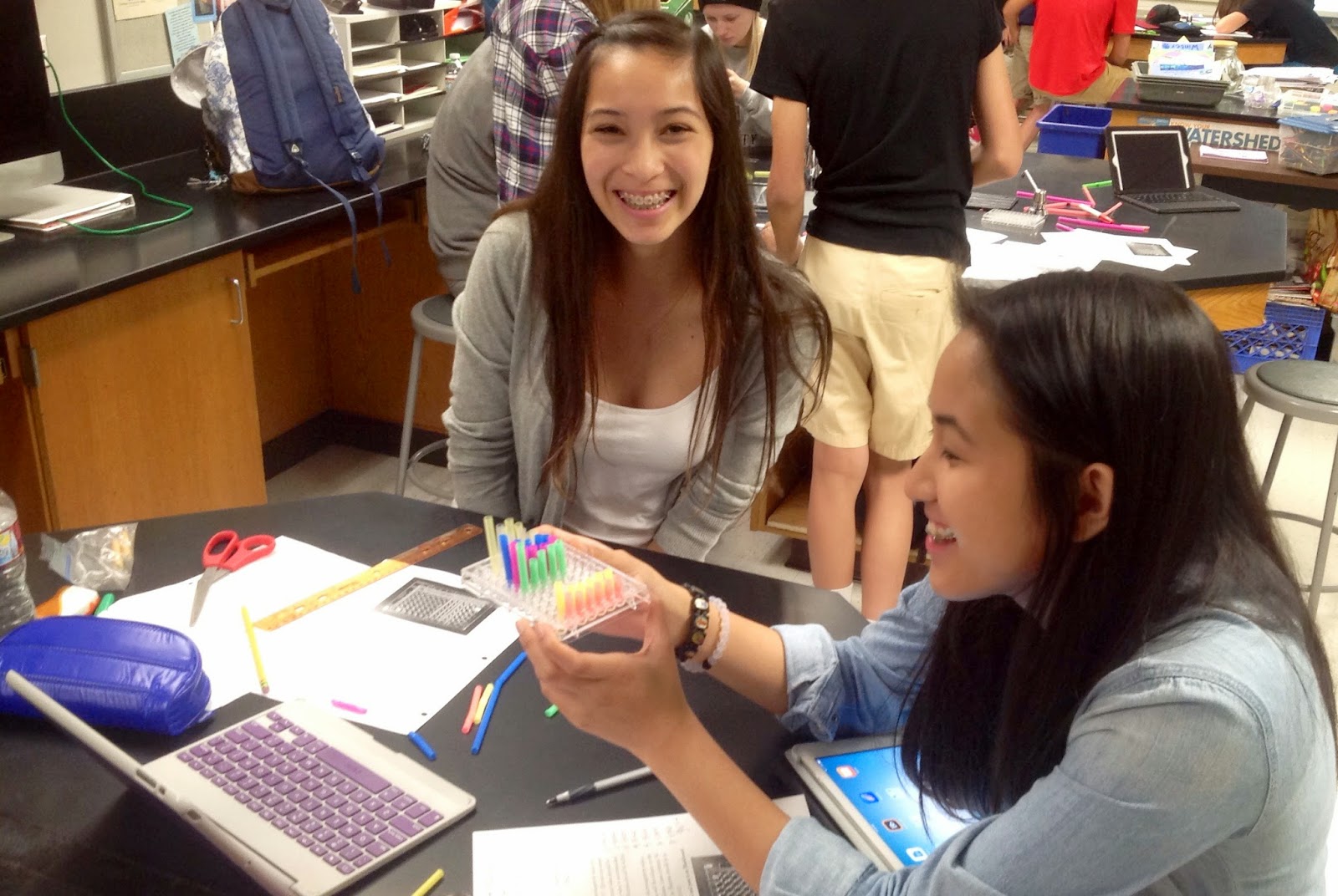
STUDENTS BUILD MODELS TO APPLY AND SYNTHESIZE FLIPPED CONTENT
Models can be a highly effective means of providing pathways for students to synthesize and apply the content they are provided.
In the Flipped Classroom I have adopted for my chemistry courses it has become an essential aspect of the curriculum, to use student developed models to transition from the media content they view at home to the application of the material in the classroom.
Models can range from simple to complex but I have found that it is the simplicity of a model that students can truly develop their own understanding and insights in a way that allows them to share with their peers and take ownership of their knowledge.
We recently used a Bohr Model template and clay to introduce the structure of the atom, the arrangement of subatomic particles and the intricacies of isotopes, and ions.
Students built models, took pictures on their iPads and annotated them using a an app called Skitch and then created iMovies about the isotopes of the first 20 elements. Although the Bohr Model has several flaws and is not a true arrangement of the electrons of an atom, building these models laid a solid foundation for students as they continued into the cloud model, electron and orbital configuration and eventually to Lewis Dot structures and the VSEPR models.
Prior to Flipping my classroom I would not have had time to have students do this in class and be able to have the more in depth discussions I engaged in with my students concerning the importance of electron arrangement, density of the nucleus, the neutron as the the defining value of the atom and the shielding effect created by the neutrons, all generated from student questions and discussions I overheard as I was fulfilling my role as "Guide on the Side" rather than "Sage on the Stage".