Showing posts with label Science. Show all posts

Tuesday, February 3, 2015

What I Learned from Watching Student Produced Chemistry Videos

Assignment: Balance Word Equations Video

Use iMovie, Explain Everything or any software or app, you are comfortable with, to create a YouTube video explaining how to balance a chemical equation from a word problem including determining classification of the type of reaction taking place..  You may use any means necessary to explain the process, white boards, table tops, presentation software, pen and paper.  

Upon completing your video, post it on the class YouTube Site. 

email: $%$$%$%%$%$%$
password: %#$%#%$%$

Please copy and paste the url for your YouTube video in the WRITE SUBMISSION box below.

(We use BlackBoard as our LMS)

A   aluminum bromide + chlorine gas yields aluminum chloride and bromine gas
B   sodium phosphate + calcium chloride yields calcium phosphate + sodium chloride
C   potassium phosphate + aluminum nitrate yields potassium nitrate + aluminum phosphate
D   sulfuric acid + sodium hydroxide yields water + sodium sulfate 
E   zinc metal reacts with lead nitrate to yield zinc nitrate and lead

Your reaction is determined by where you are seated at your tables.

^Front of Room
Door SideLab TablesWindow Side 

In years past, I would have assigned a worksheet of 20 problems of balancing word equations for students to complete at home.  I wish I could say that I am the type of teacher that would have sat down and corrected each of the 20 balancing equations for each of my 50 Honor Chemistry students, complete with corrections and personal notes to help the students understand their mistakes, but I am a realist and like most of you this would have been a check your answers   with your partners and turn it in, check mark and record assignment. 

However, this year I am having students post videos on our class YouTube Channel. These videos are meant as a means of students demonstrating their understanding of the process of solving problems. Although it takes just as much time to sit down and watch fifty 4 to 5 minute videos as it would to correct the papers, I have found the time more beneficial for both me as an educator and my students. 

I have learned more about what my students understand and what I may need to evaluate in my own teaching as a result of students completing these videos. Not to mention that students now have a library videos demonstrating both good and bad problem solving as a resource for learning and review. 

Benefits of the Video Assignment

- Students make a more honest attempt to understand because their work will be on public display. 
- Students become more aware of the importance of process versus just finding the right answer.
- Students take greater ownership of their learning.
- Students can teach and learn from other. 
- Students are immersed in the technology.
- Students are creating their own learning resource.
- Students gain skills in organization and planning.
- Students develop presentation skills.
- Students utilize proper vocabulary
- Students self assess work. 

For me as an educator, I gain more from listening to a student solve one problem than I would correcting twenty problems.  I can see and hear where students demonstrate a thorough understanding and where there may be gaps in their comprehension of the material. I can determine which areas of the topic I need to re-teach and which students I need to pull aside for additional instruction. 

 
Every student has a movie studio in their pocket or backpack between all of the software and apps that allow students to make their own videos.  Putting this to use as a means of creating a teaching and learning assignment is almost a no-brainer.  The benefits in my classroom have been tremendous. 


Saturday, October 18, 2014

MORE MODELS SOLIDIFY CONTENT KNOWLEDGE

PERIODIC TREND MODLES BUILD ON CONTENT KNOWLEDGE


"Mr. Miller, did you realize that the periodic table is arranged in more ways than just atomic number?"

"There is a definite pattern that for the elements!!!"

These are just two of the many statements that students shared with me as they built models based upon electronegativity and ionization energy in class this week.


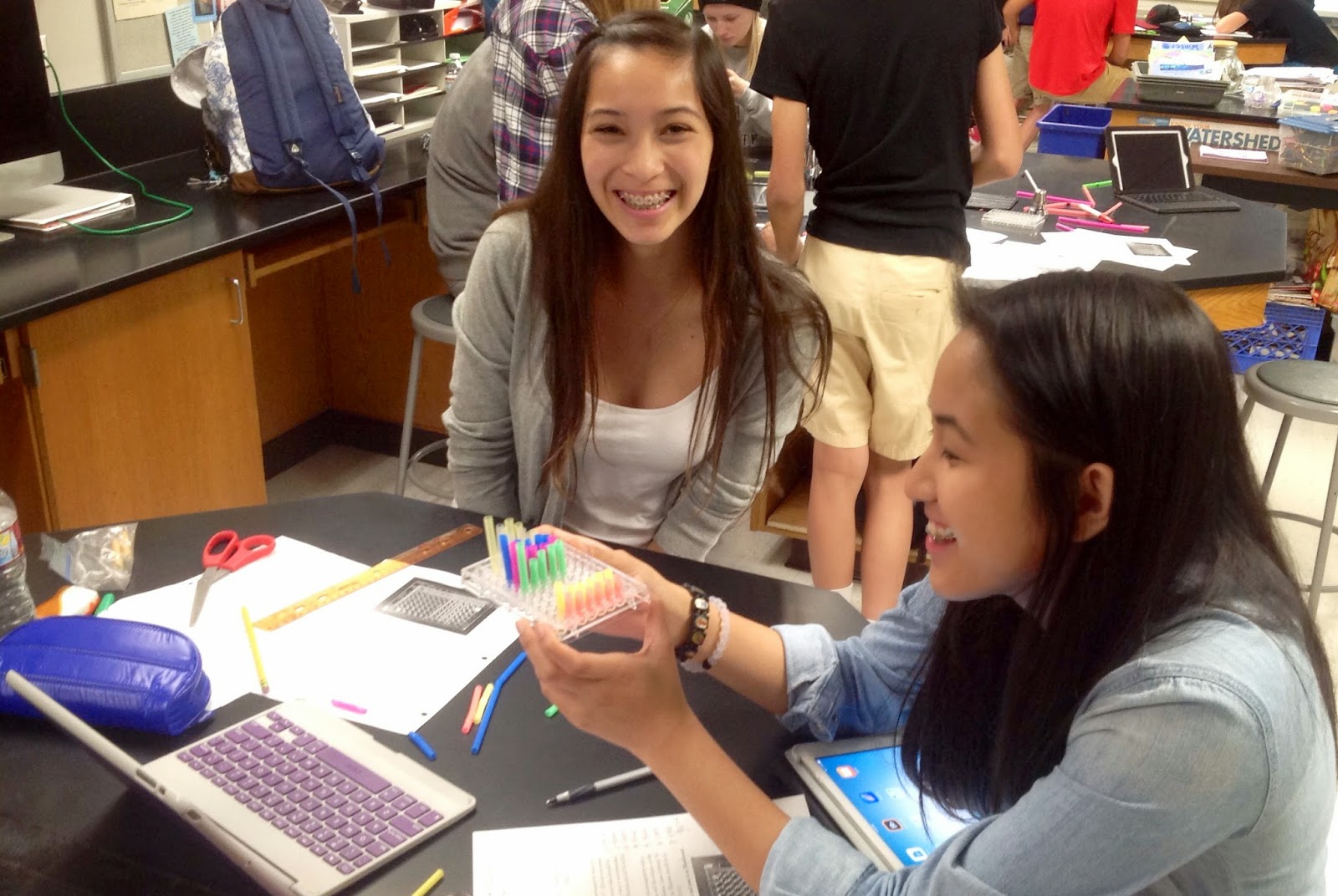
The Periodic Trends Lab (Electronegativity in 3D) is very basic and utilizes drinking straws (color straws @ Smart & Final) and a 96 well tray. Students cut straw lengths to match the values of electronegativity values.  As students build the model they can see they very distinct pattern of the periodic arrangement of the elements based upon electronegativity.  


Students followed up the Electronegativity trend model by creating a similar model for Ionization Energy using a scale of 1 cm = 300 kJ.  


MODELS - APPLY AND SYNTHESIZE FLIPPED CONTENT

STUDENTS BUILD MODELS TO APPLY AND SYNTHESIZE FLIPPED CONTENT

Models can be a highly effective means of providing pathways for students to synthesize and apply the content they are provided. 

In the Flipped Classroom I have adopted for my chemistry courses it has become an essential aspect of the curriculum, to use student developed models to transition from the media content they view at home to the application of the material in the classroom. 

Models can range from simple to complex but I have found that it is the simplicity of a model that students can truly develop their own understanding and insights in a way that allows them to share with their peers and take ownership of their knowledge. 

We recently used a Bohr Model template and clay to introduce the structure of the atom, the arrangement of subatomic particles and the intricacies of isotopes, and ions. 

Students built models, took pictures on their iPads and annotated them using a an app called Skitch and then created iMovies about the isotopes of the first 20 elements. Although the Bohr Model has several flaws and is not a true arrangement of the electrons of an atom, building these models laid a solid foundation for students as they continued into the cloud model, electron and orbital configuration and eventually to Lewis Dot structures and the VSEPR models. 


Prior to Flipping my classroom I would not have had time to have students do this in class and be able to have the more in depth discussions I engaged in with my students concerning the importance of electron arrangement, density of the nucleus, the neutron as the the defining value of the atom and the shielding effect created by the neutrons, all generated from student questions and discussions I overheard as I was fulfilling my role as "Guide on the Side" rather than "Sage on the Stage".


Thursday, October 2, 2014

FLIPPING IS MORE THAN JUST WATCHING VIDEOS AT HOME

What is Flipping and Why?

I have flipped parts of many of my classes for several years now.  I have flipped parts of Anatomy, Biology and Chemistry courses.  This year I have committed to FLIPPING my entire Honors Chemistry Course.  I use SOPHIA.org to create tutorials and playlists of my videos (SMARTERTEACHER Sophia) which are available also available on You Tube. I use Screencast-o-matic to create my own video lessons, and supplement my own videos with videos from Tyler Dewitt, Paul Anderson (Bozeman Science), Brian Swarthout and Steve Spangler and Crash Course. I have now completed the first five weeks of the course and four chapters of the text. My students have engaged in labs, hands on activities and projects in every block this year (See Page).   

I have put together a brief video to explain this to the parents of my students. 


    The Best Aspects of Flipping My Class

  • Student Focused Classroom
  • Authentic Application
  • Improved use of Technology
  • Student Ownership of Their Learning
  • Use of Formative Assessment
  • TIME, TIME, TIME!!!!!
Student Focused Classroom
My classroom has become more them and less of me.  I spend more time engaged in authentic discussions with the students addressing their questions and understanding. I have spent very little time in lecture, directing the class and in disciplining students.

Authentic Application
My students have had ten class meetings and have done a lab, hands on activity or engaged in project based learning. (See Page)

Improved Use of Technology
We became a one to one iPad school this year and have converted from Moodle to BlackBoard for our LMS. I have increased the the interaction for my students and technology.
  •  Students access the BlackBoard LMS on their iPads
  •  Students download pdfs of lecture notes and worksheets and upload them to Notability to take notes or complete work.
  •  Periodic Table is a html interface for students to access on the iPad
  •  Students have downloaded and followed lab instructions on their iPads
  •  Students have used the iPad to document lab data and observations.
  •  Students use the iPad calculator to complete problem solving
  •  Students have created photo collages and iMovies of class activities and labs
  •  Students have used the Skitch app to annotate photos of lab observations
  •  Students have followed lessons on NearPod app
  •  Students have accessed SOPHIA Playlists and Tutorials on their iPads
  •  Students have used the iPads to search information and research
  •  Students have viewed TEDs and completed TEDitorial assignments on iPads
  •  Students have created Infographics using their iPads
  •  Students have submitted discussion points to a Padlet Graffiti Wall on the SMART Board. 
Student Ownership of Their Learning
Students learn on their time at their pace. Students are able to access Sophia playlists whenever the can wherever they are.  

Increased Use of Formative Assessment
I am more aware of student understanding and application of material by having the time to authentically engage with students beyond simply sharing content. I am therefore, able to evaluate the learning process in my classroom for both my students and as an educator. 

TIME! TIME! TIME!
Time in class to engage in the types of activities that engage students in the development of their skills for learning. 


Tuesday, September 23, 2014

How Far Does Your Impact Reach?

Yesterday, I celebrated Fifty-Three years on the earth. It doesn't seem as bad when you write it out in words rather than digits. As birthdays go I really don't worry about them anymore or think about celebrating them too much.  I'm feel a little to old for cake and ice cream and not quite old enough to celebrate how long I've survived. But, yesterday I was blown away. And reminded why I teach.

A former student who kicked and screamed and cried and pleaded and pouted her way through high school, asking the very questions we as educators dread, "When, am I going to use this in real life?", "Why do I have to take subjects I hate?", "Why is "SCIENCE" so hard?" I am sure you have heard them all as well.

She showed up with the most beautiful representation of appreciation I could have ever imagined.  A cake in my favorite candy bar flavor, "Milky Way, Simply Caramel".  Emblazoned with the Periodic Table I created for the Chemistry classes here at La Salle High School.

She explained that she had spent the weekend, testing and re-testing four different cakes until she got the flavor and consistency just right for the final product.  She had another student who I tutor sampling to make sure the cake was just right. This sounds like the "SCIENTIFIC METHOD" at work. So much for,"When I going to use this in real life?" I would say there might have been a little bit of CHEMISTRY involved as well.

She went on to explain how she went online to find a copy of the periodic table that I created for the chemistry class she took. She then used food coloring to mix and match while dyeing the fondant to match the colors from the periodic table. Seems like a little bit of "SCIENCE" in action there.  Maybe even a little bit of PHYSICS, where I taught her about additive and subtractive colors. 


Now this Nursing (SCIENCE) student in her sophomore year in college explained how she recreated each element square of the periodic table with Symbol and Atomic Number, Group, Family and Period and painstakingly lined them up to complete an almost perfect replica of the Periodic Table. 


It was so beautiful, I didn't want to cut it. But, she insisted I need to taste it because she had to make sure that the Simply Caramel flavor was correct. 

Upon sharing this experience with my department colleagues, the overwhelming reaction was, "What an impact I must have had on this individual."  I always knew that as much as she complained about her high school experience, she did appreciate the opportunities for education she experienced in my classroom. But this was way beyond what I could have ever expected. 

So, Why do I TEACH?  

Because, I never know how far the experiences of my classroom will reach.

Oh  and by the way.  I think she used a few of the 6 C's in the process as well, Critical Thinking, Communication, Collaboration, Culture, Creativity, Connectivity. 

Yep!!! They were all in action.


Thursday, July 10, 2014

THE VALUE OF INFORMATION - INFOGRAPHICS IN THE CLASSROOM

THE VALUE OF INFORMATION - INFOGRAPHICS IN THE CLASSROOM

In today's world of mass media and technology, students are exposed to more information in a week than an adolescent would see in a lifetime in Shakespeare's time. 

The ability to absorb, interpret, filter, store, categorize, evaluate and share this information seems to be an overwhelming task but the digital natives of this generation seem to be well adjusted to the glut of information broadcasted to their world. 

One mean of collating information that has become quite prevalent in today's world digital communication is the "infographic". 
 

The definition from Wikipedia states,  Information graphics or infographics are graphic visual representations of information, data or knowledge intended to present complex information quickly and clearly. 

This summer in my sophomore Health course we have used info graphics in a variety of ways.  

First the students viewed the documentary "Escape Fire" to gain perspective on the Health and Wellness Care System in United States. Utilizing infographics provided on the movie website (http://escapefiremovie.com/first-aid-kit) students evaluated and correlated information from the documentary.   

Next students used infographics to gather and analyze information concerning prescription and OTC drugs.  I provided them with variety of infographics about various topics concerning the pharmaceutical industry and health care. Students worked in groups to break down and evaluate the information on the infographics and then present the most valuable information to the class. 


Students also evaluated the effectiveness of the infographic as a means of conveying information.  Students analyzed and presented the  organization, presentation, color schemes, chart and data choice for each infographic.       


Finally students worked in groups to create their own infographics concerning one of the six issues raised in the documentary regarding our health care industry. Each infographic had to contain 8 to 12 data based sets of information presented in chart form with accompanying text. 
Students posted and shared their infographics online.  


For me this project provided the perfect means to incorporate the Six C's of Education.  Students add to Think Critically to analyze and evaluate data, gather information and format the infographic. Students worked in Collaborative Teams in student to student and online collaboration. Students Communicated in a variety of means throughout the project whether working in groups or presenting online or in the classroom. The design and production of the infographic provided an avenue to develop their Creativity. Analyzing data and looking at the effects on society of our health and wellness infrastructure forced students to evaluate the Culture they are living in. Lastly, students Utilized smartphones, iPads, and computers to Connect the dots and produce their infographics.


Tuesday, April 15, 2014

Fluorescent Engagement on Lab Table Tops

Fluorescent Engagement on Lab Table Tops

I believe as long as there have been desktops there has been a constant battle to keep students from writing on the desk. 

But, what if there were a way to allow students to write on the desk in order to engage them in the learning process.

That is where fluorescent markers and black lab tables have found a happy marriage in my classroom.

In Environmental Science students use a practice called TABLE TOP GRAFFITI to Brainstorm key points and ideas from the semester. 


Using the Fluorescent markers students can write on their desktops to their hearts content, as long as they are working on chemistry. Students work in pairs to problem solve using the table top as their shared workspace.


Ideas For the Classroom 

  • Pre-written PODs as students come into the classroom.
  • Homework review.  Students share specific problems from their homework. 
  • Students teach each other. To both assist others and to reinforce their own learning. 
  • Students work through problem solving before transferring work into their notes.
  • Brainstorming.
  • Writing out lab procedures. 
  • Recording data, before transferring it to their lab notebook. 
  • Flow charts for work. 
  • Recording discussion notes for sharing with class. 
  • Museum walks of completed work. 
  • Thought questions or quotes to prompt discussion.
  • Whatever your mind can imagine.    


Monday, April 14, 2014

Poetry in Science - The Diamante

Poetry in Science - The Diamante 

Today's students chat with Facebook friends all over the world, play online games with  groups of people located in different states, transfer money from their savings to their checking while standing in line at a food truck, and enter movie theaters by scanning a barcode on a cyber ticket they purchased while traveling on the Metro across town.  All of these activities take place through technology that was not available less than a decade ago.

Their world shrinks with the same frequency as the technology they use. The entire world has become their neighborhood. There has never been a generation that is as interconnected as this generation. 

And yet, our educational system is based upon compartmentalization.  We spend fifty to one hundred minutes with twenty-five to thirty students in a twenty by twenty room isolating subject matter to a single topic.  We are now going to study Biology.  It is now time for Geometry.  This is History period. In a completely interconnected world, why do we spend so much time and effort disconnecting the subjects we teach? 

This system of pigeon-holing the curriculum makes it excessively more difficult for the students of today to understand the links and overlaps in the curriculum they are exposed to. As a science educator I have noticed an alarming trend in the last few years, of students being resistant to the idea that what they learn in every classroom is pertinent across the curriculum  They do not always see nor do they always understand that the math they do in algebra is the same math they will use in chemistry and physics.  The grammar rules and essay patterns in English are basically the same as those used in writing a paper in biology or environmental science.  The analysis and understanding of cause and effect in history is the same as the skills necessary to understand cause and effect concepts in any science subject.

How can we discontinue this disservice to our students and discover methods to incorporate the values and lessons of all subjects across our curriculum?

Simplicity is the key.  We must find ways to consistently integrate cross curriculular activities into our classrooms.  A very simple method I have incorporated, is the use of a poetry style called a Diamante.  Students in my science classes write diamante poetry to demonstrate the interconnections and cyclical patterns of the information we teach and learn. The diamante follows a simple 1-2-3-4-3-2-1 pattern

Noun
Adjective   Adjective
Participle   Participle   Participle
Noun           Noun             Noun           Noun
Participle   Participle   Participle
Adjective   Adjective
Noun

The diamante can be about any topic and can be written for any subject.  It provides an opportunity to integrate English poetry into science or math, history or physical education.  I ask students to take two nouns that are opposites or unrelated and create a diamante.  The middle four nouns are the link between the topics.  The completed diamante can be read from top to bottom or bottom to top and should still make sense. 

Students then write their poems on two sheets of different color construction paper with the four linking nouns written on the seam.  They then tap into their artistic side and decorate the poem and share them with their classmates.

Union
Blue    Yankee
Marching  Shooting  Charging
Father    Brother     Brother     Son
Yelling    Fighting    Attacking 
Rebel     Gray
Confederate

The idea is quite simple but offers an opportunity to create discussion points about the importance of understanding the integration of not only the different academic subjects but of all people, processes and  things. 


John Muir
"When we try to pick out anything by itself, we find it hitched to everything else in the Universe."

Saturday, April 12, 2014

Colligative Properties - And Its So Tasty Too!!!

Colligative Properties - An Its So Tasty Too!!!

What if everyday your students came to the door of your chemistry classroom with ANTICIPATION and EXCITEMENT?

What if your chemistry students spent more time smiling in your class than grimacing with angst over another lecture or worksheet?

What if you couldn't wait to get to your chemistry class because you wanted to see how your students would respond to the activities you have planned for that day?

What if you made ICE CREAM and ate it in the science lab and students grasped the concept of freezing point depression and were excited about how to calculate colligative properties because they have an answer to the age old question of "When am I ever going to use this in life?

Well, this is just a tiny part of what I get to experience since adding FLIPPED LEARNING to my education environment. And while the flipped model is not a silver bullet for education, it is a means of creating a more engaging, hands on, student centered classroom.

Let's face it, freezing point depression and boiling point elevation in a lecture-worksheet classroom experience is not one of the most engaging pathways to student learning. But throw in a couple of baggies, some whole milk, whipping cream, sugar and vanilla, a whole lot of ice and some salt and all of a sudden you have smiles, laughter, cold hands, warm hearts and a great learning experience for students that will be part of discussions with peers and parents  and will be most definitely be part of discussions at 10, 20 and 30 year class reunions.  And isn't that when the students own the learning?  When they can articulate the experience beyond your classroom walls. 


So after students completed their flipped lesson playlist for colligative properties on SOPHIA we took a Friday afternoon and the following recipe and solidified our understanding of freezing point depression by making ice cream and a whole lot of smiles. 


  • 1/2 cup milk
  • 1/2 cup whipping cream 
  • 1/4 cup sugar
  • 1/4 teaspoon vanilla or vanilla flavoring 
  • 1/2 to 3/4 cup sodium chloride (NaCl) as table salt or rock salt
  • 2 cups ice
  • 1-quart freezer bag
  • 1-gallon freezer bag
  • themometer
  • measuring cups and spoons
  • cups and spoons for eating your treat!
Add the milk, whipping cream, sugar and vanilla to the 1-quart bag.  Squeeze out as much of the air as possible and seal the bag. Place the sealed bag into the 1-gallon bag and surround it with the ice. Pour in the salt and seal the 1 gallon bag. Massage the contents until the ice has melted completely. Students may want to wrap the bag in a towel as the bags get very cold. 
When the ice cream has a texture and viscosity, open the 1-gallon bag, remove the 1-quart bag, discard the melted ice and bag. Now grab a spoon and enjoy the fruits of your labor. 

The learning moments abound as students question, "Why does the ice get so cold?" and,  "How does the liquid thicken?"  But I think the best question is, when they ask, "Can I do this at home?" Because then, I know that I have got them!!!!  And I know they will be coming back for more!!!


Thursday, April 10, 2014

PBL - Left Brain Teacher vs. Right Brain Student

PBL
Left Brain Teacher vs. Right Brain Student

Too often as educators we design assignments that meet 
our ease and comfort. 
We schedule due dates and create format details that meet "our" needs for "our"curriculum.  
But, do we look at the students needs? 


Tuesday, April 8, 2014

I am not a MATH and SCIENCE Person

I am not a MATH and SCIENCE Person

"Science is a way of thinking, much more
than it is a body of knowledge."
                                                                                    -Carl Sagan-

According to a recent recent test of 250,000 fifteen year olds from forty-one industrialized nations the United States ranks 27th in science skills.  The country responsible for light bulbs, television, putting a man on the moon, microwave ovens, the computer revolution and the clapper, is in a free fall from the top of the pedestal of scientific discovery.

My science colleagues and I have had a long running joke about providing badges of honor to the teachers we meet who proudly claim that they are not math and science people.  And yet, heaven forbid a science teacher who does not know what a sonnet is (a 14 line poem based upon a single thought or expression in one or more rhyming schemes), or when the War of the Roses was fought (the civil wars of England fought from 1455-1485).   
Introducing myself as a chemistry  educator, I invariably have to field the question, "Do you still have students memorize the periodic table?" as if the only thing you need to do in chemistry is first memorize and second know the atomic number, mass symbol and name of the first 20 elements in order to know chemistry. 

Too often in today's educational landscape science education suffers because the foundations are not set early in the elementary or junior high levels.  Typically, because the grammar school teachers are liberal arts majors who have little or no background in the field of science and therefore transmit their discomfort to their students.  Now don't get me wrong. There some amazing science teachers and science programs throughout the country.  But after music and art are diminished due to budget cuts, and PE is decreased so that more time can be spent preparing students for standardized tests, the next subject to suffer, is science.  Funding issues, lab materials, complexity of lab set up, and teacher discomfort lead to Science becoming a perfunctory exercise in reading the text and answering the questions at the end of the chapter. 

I have volunteered my time during the last several years to assist middle school and junior high teachers in developing a more hands on science curriculum.  These teachers have a desire to enhance their curriculum with more labs and activities.  Their classrooms are equipped with wonderful science kits paid for by the district to coordinate with their text.  However, they are paralyzed by the fear of the unfamiliar and doing something wrong. I do not blame these teachers. Teacher preparation and crriculum development programs are usually lacking in opportunities to experience the intricacies of teaching science. 

When these students leave their junior high schools they are fortunate if they have used a microscope or experienced a dissection. Science learning has been narrowed down to a series of handouts and rote memorization.  The process of science is not one of critical thinking about the possibilities of investigation but simply finding a correct answer.  They have not experienced the joy of putting something together and making it work successfully or the even greater moment of something not working and figuring out how to make it work.

Just as educators should allow students to experience failure as a means of growth and learning, teachers too, should be willing to fail and make mistakes.  In fact what better way for students to value the process of learning from mistakes than to experience that process alongside a teacher.

Have fun, tinker, experience, build-destroy-rebuild, do, plan, make, mix, join, break, fix, play, understand, work, learn, guess, error, guess again, adjust, adapt, see, discover.

"Science is built up of facts, as a house is built of stones; but an accumulation of facts is no more a science than a heap of stones is a house."
                                                                            -Henri Poincar-