Showing posts with label Sophia. Show all posts

Thursday, July 24, 2014

SOPHIA ENDORSED BY "FLIPPED" STUDENT

SOPHIA ENDORSED BY "FLIPPED" STUDENT

As part of my courses I always provide an opportunity for students to evaluate and review the course. 
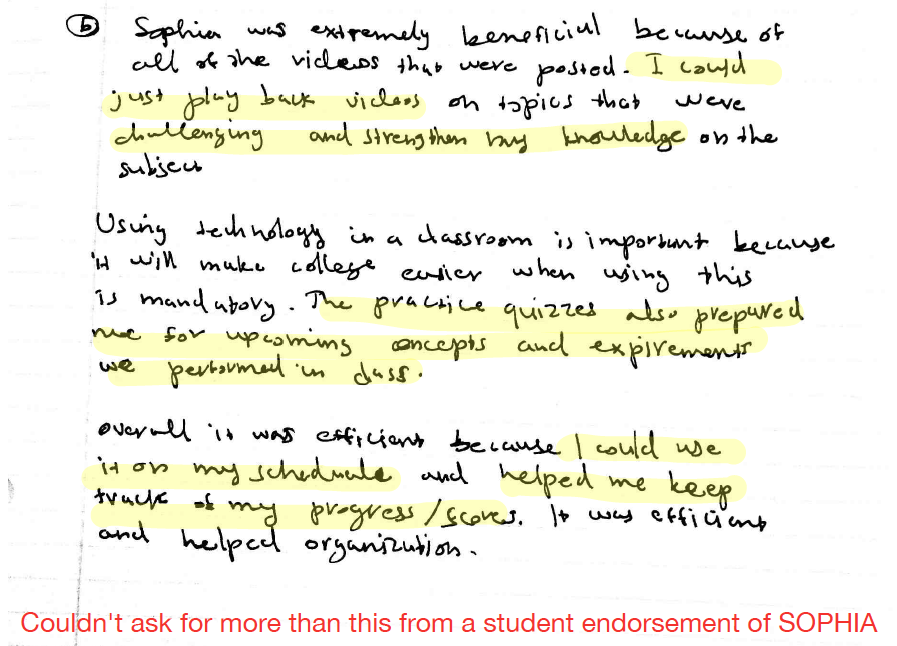
One of the questions on my Summer Biology Hybrid Course, was "How was your process of learning affected by the use of the  SOPHIA website.


As a proponent of the "Flipped Classroom" and having used SOPHIA for several semesters now, I can't tell you how excited I was when I read this commentary from a student from my class. This answer basically looks like she read the manual for teaching in the flipped classroom as she hit most of the key points that "Flippers" claim as the benefits of the "Flipped Classroom".


Tuesday, June 3, 2014

FLN and SOPHIA Flipped Learning Infographic Continued

FLN and SOPHIA Flipped Learning Infographic Cont. 

Continued information from the survey surrounding the growth of "Flipped Learning"

http://bit.ly/1hWqrgS


Thursday, May 15, 2014

Growth in Flipped Learning Infographic

Growth in in Flipped Learning Infographic 
from SOPHIA 


Sophia and the Flipped Learning Network collected the data in a survey earlier this year. 


Thursday, May 1, 2014

Featured Teacher on SOPHIA

Featured Teacher on SOPHIA


In January I adopted the SOPHIA website as a means of delivering content for my Honors Chemistry class.  I create Tutorials and Playlists for students to view and complete work at home.
Both my students and I ave been very pleased with the SOPHIA site which is run by Capella University and Bill Nye (The Science Guy). I have completed professional development programs online through SOPHIA/Capella on the Flipped Classroom, iPads in the Classroom and the Virtual Classroom. I have shared SOPHIA in my department and have been a featured contributor to the School of Thought Blog.


This month SOPHIA has chosen me as the Featured Teacher for the use of Technology in the classroom. The link below will take you to the SOPHIA website.  

Saturday, April 19, 2014

Organize Your Videos Like a Coach

Organize Your Videos Like a Coach

Confucius said,

“I hear I forget,
I see I remember,
I do I understand”

The Four Principles of Teaching - John Wooden

Explanation

Demonstration

Imitation

Repetition

One of my mentors in education is the Late Great John Wooden.  I use his pyramid of success in my classroom as a model for Educational Excellence.  His approach to coaching and education are timeless and can be adapted for any subject matter. Whether you are teaching addition and subtraction, or the quadratic formula, the bones of the skeleton or the eight steps of digestion, a lay-up or the intricacies of the half court trap, to be an effective educator the steps do not change.  The educator must be able to provide the student each of these four levels of the teaching process in order to impart knowledge.

Explanation must include both the basic how, what, when and where, but most importantly the why.  If the learner cannot understand he value of the information or skill, the knowledge will not be passed on to long term memory.  In order to become a useful part of the student's knowledge base, there must be a need to associate it to previous knowledge as well as future need.

Videos need to be a clear and concise explanation, of what the information is, why it is important and how it can be used.

Demonstration must be done without a preconceived idea of what the learner knows.  The demonstration should address all aspects of the skill from the most rudimentary step to the ultimate conclusion. Demonstration must include the basic steps from beginning to end. Even the most experienced student should find value in reviewing the  basic components of a process or skill.

Videos should provide enough examples to demonstrate the process of utilization of the information. 

Imitation must provide the opportunity to succeed without a fear of failure but an incorporation of failure with correction as a means of understanding.  Students should be provided the opportunity to mirror the instructor throughout the process or skill.  It is through imitation that the student gains an understanding of the concept and a confidence in their own ability to succeed.

Videos should offer gaps for students to imitate the process with immediate feedback.


Repetition must be enough to develop a comfort level while keeping the information fresh.  Avoid at all costs the drill and kill that is detrimental to the ultimate goal of learning. Repetition should provide insight for both the instructor and the student as to the level of mastery and the need for further instruction and/or practice.  Repetition should serve as the measuring stick as to the next steps in the learning process.

Lastly, the video should provide opportunity for the students to continue the process on their own. 

Saturday, April 12, 2014

Colligative Properties - And Its So Tasty Too!!!

Colligative Properties - An Its So Tasty Too!!!

What if everyday your students came to the door of your chemistry classroom with ANTICIPATION and EXCITEMENT?

What if your chemistry students spent more time smiling in your class than grimacing with angst over another lecture or worksheet?

What if you couldn't wait to get to your chemistry class because you wanted to see how your students would respond to the activities you have planned for that day?

What if you made ICE CREAM and ate it in the science lab and students grasped the concept of freezing point depression and were excited about how to calculate colligative properties because they have an answer to the age old question of "When am I ever going to use this in life?

Well, this is just a tiny part of what I get to experience since adding FLIPPED LEARNING to my education environment. And while the flipped model is not a silver bullet for education, it is a means of creating a more engaging, hands on, student centered classroom.

Let's face it, freezing point depression and boiling point elevation in a lecture-worksheet classroom experience is not one of the most engaging pathways to student learning. But throw in a couple of baggies, some whole milk, whipping cream, sugar and vanilla, a whole lot of ice and some salt and all of a sudden you have smiles, laughter, cold hands, warm hearts and a great learning experience for students that will be part of discussions with peers and parents  and will be most definitely be part of discussions at 10, 20 and 30 year class reunions.  And isn't that when the students own the learning?  When they can articulate the experience beyond your classroom walls. 


So after students completed their flipped lesson playlist for colligative properties on SOPHIA we took a Friday afternoon and the following recipe and solidified our understanding of freezing point depression by making ice cream and a whole lot of smiles. 


  • 1/2 cup milk
  • 1/2 cup whipping cream 
  • 1/4 cup sugar
  • 1/4 teaspoon vanilla or vanilla flavoring 
  • 1/2 to 3/4 cup sodium chloride (NaCl) as table salt or rock salt
  • 2 cups ice
  • 1-quart freezer bag
  • 1-gallon freezer bag
  • themometer
  • measuring cups and spoons
  • cups and spoons for eating your treat!
Add the milk, whipping cream, sugar and vanilla to the 1-quart bag.  Squeeze out as much of the air as possible and seal the bag. Place the sealed bag into the 1-gallon bag and surround it with the ice. Pour in the salt and seal the 1 gallon bag. Massage the contents until the ice has melted completely. Students may want to wrap the bag in a towel as the bags get very cold. 
When the ice cream has a texture and viscosity, open the 1-gallon bag, remove the 1-quart bag, discard the melted ice and bag. Now grab a spoon and enjoy the fruits of your labor. 

The learning moments abound as students question, "Why does the ice get so cold?" and,  "How does the liquid thicken?"  But I think the best question is, when they ask, "Can I do this at home?" Because then, I know that I have got them!!!!  And I know they will be coming back for more!!!


Monday, April 7, 2014

SOPHIA - Classroom Follow-Up

SOPHIA - CLASSROOM FOLLOW-UP


I adopted the use of the SOPHIA learning platform in my Honors Chemistry course in February, 2014.  It is a work in progress and both my students and I are learning the benefits and the nuances of this SOPHIA portal as a system for sharing knowledge.

I first must preface this with the fact, that my Honors Chemistry class is a fantastic group of students and they have fully bought in to the concepts of learning that are the cornerstones of my classroom:

1. Our learning environment is predicated on the concept of the 
6 C's: Think Critically, Communicate Clearly, Work Collaboratively, Develop Creativity, Embrace Culture and Utilize Connectivity


2. I teach learning on a path called chemistry.  If you learn how to learn the content will take care of itself.

3. We will remember 92% of what we teach someone else, 30 days afterward. We teach to learn.

4. Success is measured by the definition of success according to John Wooden, “Success is peace of mind which is a direct result of self-satisfaction in knowing you made the effort to become the best of which you are capable.”


I use SOPHIA to create tutorials using my own videos and other online resources and gather them into playlists of the content aspects I want students to learn.  These SOPHIA playlists are posted on Monday and they are due on Sunday by 11:00 pm. The material is always presented online the week before we will be working on it in class.  

This model has allowed me to get students more involved in their own learning, conduct more lab work and develop more real life assignments, activities and discussions in class. We work in a block schedule with 95 minute classes and I see this class every other day.

On the Monday morning, I check the SOPHIA portal for the class content page to see who has completed the playlist and who may have struggled based upon the number of questions necessary to complete the three questions to move on in the playlist. After four playlists I am experiencing a 96% completion rate for my students.

One of the formative assessment practices I use in for a class activity to check for student understanding is to have students solve PODs in partners on the Monday or Tuesday following the due date.  I have six octagonal lab tables in my lab and put two questions, one on each side of the table for students to complete.  Students work together through the problem solving.  They are given 2to 2 and half minutes to complete the question before rotating.  This process has afforded me and my students tremendous insight into their understanding:


1. I can listen to student discussions of the problem solving process.


2. Students can ask me questions throughout the process for clarification.

3. Students who have not completed the playlist are brought up to speed by their peers.

4. Students solidify their own understanding by sharing with a partner.

This process allows me to take on the role of "guide on the side" rather than "sage on the stage", making students responsible for their learning and allowing them to take ownership of their knowledge. 

While, this is an a Honors Chem class and these students do tend to be more motivated, the effectiveness of using platforms like SOPHIA or incorporating the FLIPPED model is entirely dependent upon the environment of learning that becomes the culture of the classroom.


Tuesday, March 18, 2014

Sophia - Flipped Learning Platform

Sophia - Flipped Learning Platform


Sophia is an online learning platform that provides teachers an opportunity to create tutorials, playlists and pathways for learning.  The Sophia site has been developed  through Capella University,  Bill Nye - The Science Guy, the Mayo Clinic and New Classrooms in an attempt to empower students with an online learning platform with more than 37,000 tutorials from a wide variety of educators with a vast array of educational styles to opportunity of student success. The site provides free professional development opportunities for educators to develop technology use in the classroom.  The Sophia site also provides college credit through Cappella University. 

Through the Sophia platform educators can create class groups and provide students with tutorials for guided learning and practice utilizing, video, slide presentations, pdf, Google forms and other media. These tutorials can be grouped into playlists for themed lessons, sectioned units or complete chapters.
Student progress can be monitored with embedded quizzes.

Sample Playlists